
After recently acquiring 8 properties across 6 states, we’ve learned the hard truth: rent roll reviews, systems upgrades, and property care standards only work when you have the right people implementing them.
The current market makes this even more critical. While absorption fell 73% year-over-year in Q3 2025 and new deliveries remain elevated, the properties that stabilize fastest aren’t in the best submarkets or blessed with low vacancy rates. They’re the ones where the on-site team executes from day one.
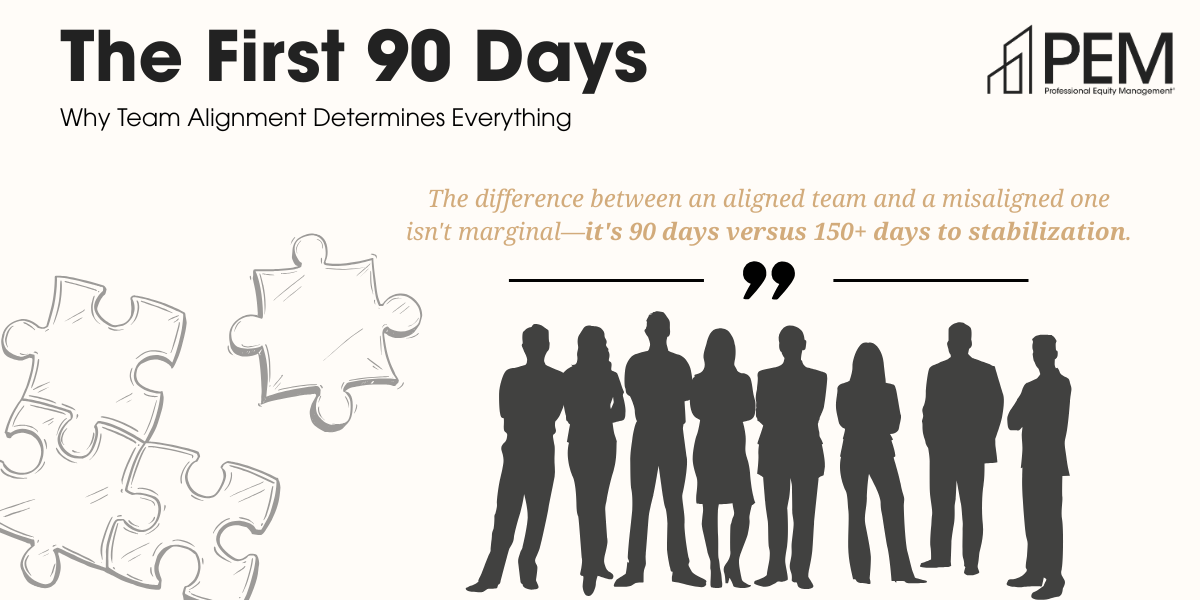
Team alignment determines everything. The difference between an aligned team and a misaligned one isn’t marginal—it’s 90 days versus 150+ days to stabilization. That 60-day gap represents over $100,000 in lost value on a 200-unit property.
The underwriting, the financing, the market selection—all of that creates opportunity. But execution determines whether you capture it.
The Truth Teller
Most operators track occupancy and turnover as their primary performance indicators. We start with accounts receivable because it tells you everything you need to know about operational performance before those other metrics even begin to move.
When a property management team is aligned with our operational standards, collections reflect it immediately. When they’re not, AR deteriorates while the team offers excuses. You hear things like “These residents have always been late but they eventually pay,” or “If we push too hard on collections, we’ll lose occupancy,” or “This market is different—people here expect more flexibility.”
The national multifamily on-time collection rate sits at 82.1%, with full payment rates around 93.3%. Properties performing significantly below these benchmarks aren’t facing market headwinds—they’re facing execution failures.
Bad tenants consume disproportionate resources. They generate excessive maintenance requests, create conflict with neighbors, fall behind on rent, and demand far more staff attention than quality residents. Moving them out quickly requires a team willing to implement what we call manage-up or manage-out protocols: clear communication of expectations, documented warnings for violations, and swift action when residents won’t comply.
A resident who’s late gets a pay-or-quit notice, not a sympathetic conversation about “working something out.” A resident who violates noise policies repeatedly gets documented warnings leading to lease termination, not endless chances based on promises to do better. This isn’t complicated, but it requires intentionality and consistency rather than selective enforcement based on sympathy or conflict avoidance.
This is where team alignment becomes visible immediately. An aligned team discusses current residents in terms of lease compliance and payment history. They ask questions like “What’s our timeline for issuing pay-or-quit notices?” or “How do we want to handle residents who are consistently 3-5 days late?”
A misaligned team sounds different. They’ll describe problem residents in sympathetic terms while avoiding accountability: “Mrs. Johnson in 204 is going through a tough time right now,” without mentioning she’s 60 days past due. They resist new processes with “We tried something like that before and it didn’t work,” or treat portfolio standards as suggestions: “That might work at your other properties, but our residents won’t respond to that approach.”
When we implemented new systems across our portfolio, adoption timelines revealed team alignment. Properties where teams embraced changes showed measurable improvements within 30 days. Properties where teams resisted took 90+ days—and those who couldn’t or wouldn’t adapt ultimately weren’t the right fit for our standards.
Reading the Room
The first 72 hours after acquisition tell you everything. Team misalignment doesn’t hide—it reveals itself in how people talk about residents, respond to new protocols, and explain property condition. This assessment window determines whether you’re looking at a 90-day stabilization or a prolonged struggle, because it shows you whether the team will execute your standards or fight them.
Pay attention to how the existing team talks about current residents. Are they discussing lease compliance, payment history, and property care? Or are they making excuses for problem tenants? “He’s going through a divorce.” “She just lost her job, but she’s been here three years.” “They’re good people, just having a hard time right now.” These explanations might sound compassionate, but they reveal a fundamental misalignment. These teams obsess over the 1-2 residents who won’t pay while forgetting the 200 who do, spending their energy making excuses for problem tenants instead of protecting the experience for quality residents.
Watch how they respond when you introduce new collection protocols or tenant qualification requirements. An aligned team asks clarifying questions and seeks to understand the reasoning behind new standards because they want to get it right. A misaligned team immediately pushes back: “That income-to-rent ratio won’t work in this market.” “Our residents won’t accept automated payments.” “The previous owner tried that and it didn’t work.” Every pushback is framed as local expertise when it’s really resistance to accountability.
The willingness to implement manage-up and manage-out strategies is particularly telling. Quality property management requires the ability to enforce lease terms consistently and exit residents who won’t comply. Teams that resist this fundamental responsibility—whether from misguided compassion, conflict avoidance, or simple laziness—will undermine every other operational improvement you attempt.
Another signal: property condition and how the team explains it. Walk the property on day one. If the landscaping is neglected, trash hasn’t been picked up from common areas, or the pool area looks like nobody’s paid attention in weeks, listen to how the team explains it. “We’ve been short-staffed,” or “The previous owner wouldn’t approve the budget,” tells you they’re focused on excuses. “You’re right, that’s unacceptable—I’ll have it addressed today,” tells you they’re focused on solutions.
Within 72 hours, you know whether you have a correctable situation or a replacement scenario. Correctable looks like inexperience or lack of training: they want to do the job right but haven’t been shown how. Replacement looks like resistance framed as expertise, the familiar refrains of “We’ve always done it this way,” or “That won’t work here.”
The decision point matters because time is money. A Community Manager earning $77,500 annually costs roughly $287 per day when you factor in benefits and overhead. Every week you delay replacing a misaligned team leader costs you $2,009 in direct compensation plus the opportunity cost of continued poor execution. Make the call and move forward.
What Execution Actually Looks Like
The first 90 days follow a predictable pattern when you have capable people executing clear standards. When you don’t, those same 90 days reveal why execution matters more than strategy.
Tenant Alignment starts with a comprehensive rent roll review against our standards: payment history, lease compliance, property care, neighbor relations. An aligned team documents findings and makes data-based decisions. A misaligned team makes excuses for poor performers and resists exiting problem residents. The difference shows immediately in AR—rigorous screening produces quality residents who pay on time. Relaxed standards produce collection problems that compound monthly.
The fraud environment makes verification non-negotiable. Recent NMHC research found that more than 90% of rental housing providers experienced application fraud in the past year, with nearly one in four evictions tracing back to fraudulent applications. The average operator wrote off $4.2 million in bad debt, roughly a quarter from fraud. We verify everything—income directly with employers and financial institutions, comprehensive background checks. Technology helps detect document tampering, but comprehensive protocols provide the real protection.
Credit Reporting serves dual purposes. According to the Urban Institute, less than 5% of rental payments nationwide get reported to credit bureaus. Quality residents build credit through on-time payments. Late payers get immediate credit bureau reporting from our inside counsel. An aligned team implements this consistently. A misaligned team treats it as optional or negotiates exceptions, training residents that standards are flexible.
Legal Process Management separates operators who protect NOI from those who watch it deteriorate. Aligned teams document everything, file immediately, and make strategic cash-for-keys offers when justified—$2,000 to avoid a four-month eviction costing $7,500. Misaligned teams delay, avoid confrontation, and lose months of rent while residents learn there are no consequences.
Systems Implementation reveals alignment quickly. Aligned teams embrace automation—rent collection, maintenance platforms, self-guided tours—as tools that improve efficiency. Properties show measurable improvements within 30 days. Misaligned teams view them as corporate impositions and circumvent rather than adopt. Those properties take 90+ days to show movement, if they implement at all.
Property Care Standards require daily execution. Aligned teams maintain properties proactively. Misaligned teams let landscaping deteriorate and trash accumulate, blaming staffing or budget. The difference isn’t resources—it’s accountability.
The indicators are consistent. AR climbs as teams make excuses rather than enforce collections. Complaints increase from inconsistent execution. Maintenance deteriorates while teams resist change.
The teams that execute well in the first 90 days tend to execute well for years. The teams that struggle initially rarely improve without replacement. That pattern holds across properties, markets, and economic cycles.
The Foundation for Patient Capital
We tell investors that real returns come from operational rigor over time, not from market timing or leverage games. The first 90 days of ownership determine whether that promise holds true for the next five to seven years.
The unsexy truth about multifamily investing: no amount of underwriting sophistication overcomes poor execution at the property level. You can buy the best asset in the best market at the best price, but if your on-site team won’t maintain standards, you’ll underperform every projection.
Conversely, competent teams can overcome challenges that would sink mediocre operators. They collect rent during market downturns. They maintain occupancy when competitors struggle. They protect NOI when expenses rise. Not because they’re lucky—because they execute.
After three decades in this business, I’ve learned that the difference between good returns and great returns isn’t found in complex financial engineering or market timing. It’s found in having the right people doing the right things every single day. The first 90 days either confirm you have that or reveal how quickly you need to make changes.
For investors evaluating operators, the question shouldn’t be about portfolio size or years in business. It should be about operational discipline: how quickly does the team identify misalignment, how decisively do they act, and what systems ensure execution happens consistently across the portfolio?
The answer to those questions determines whether your investment compounds for years or struggles for months. Most operators talk about operational excellence. Fewer can show you the systems that enforce it. Even fewer will acknowledge when those systems reveal problems that require immediate personnel changes.
This isn’t theoretical. The performance gap translates directly to investor returns—protecting NOI through market cycles or watching margins erode because you were unwilling to make hard decisions about team performance.
Staff alignment protects AR. AR stability drives NOI consistency. NOI consistency enables predictable distributions and long-term value creation. Everything flows from getting that foundation right.
The operators who succeed long-term aren’t the ones who avoid personnel problems—they’re the ones who identify them in 72 hours and fix them in two weeks, not two quarters. If this approach to operational discipline and capital stewardship aligns with how you think about real estate investing, I’d welcome the conversation.
About the Author
 Paul Mashni is the Founder and CEO of Professional Equity Management (PEM), a vertically integrated real estate investment firm specializing in multifamily properties. With over 30 years of experience and more than 26,000 apartment units acquired, Paul has successfully navigated five downturns while maintaining an average IRR of 20%+ since inception. His investment philosophy is guided by the principle that it’s “better to sell a year too early than a day too late.” His background in accounting and finance, along with his law degree from Wayne State University, informs PEM’s disciplined approach to investments. Paul holds a Bachelor of Science in Accounting and an MBA in Finance from Michigan State University.