
The call came on a Tuesday afternoon. Prudential Life, through one of our long-standing broker relationships, was considering selling Bellary Flats—an institutional-quality asset that had never hit the public market. They weren’t looking for the highest bidder. They wanted a buyer with a proven track record who wouldn’t waste time or risk a failed escrow.
Based on reference checks and our willingness to put non-refundable money into the transaction early, we were awarded the Bellary Flats deal.
This wasn’t about the size of our check. Plenty of groups had equal or greater capital. This was about three decades of proven relationships—a track record of integrity, reliability, and execution that opened doors money alone couldn’t.
Real estate has traditionally been a longer-term, passive investment. The growth of financial engineering, higher debt, and lower barriers to entry has transformed it into more of a commodity versus a long-term asset. This shift has created an industry where speed and volume often take precedence over relationship building and proven track records.
While most sophisticated investors chase the few hundred thousand public listings available at any given time across commercial real estate, we access a different market entirely. The vast majority of commercial properties never reach public markets, and this dynamic is particularly pronounced in multifamily, where quality opportunities often remain accessible only through networks established over time, not algorithms or spray-and-pray marketing approaches.
This relationship-driven approach delivers measurable results: 80% of our deals come from relationships rather than public market opportunities, demonstrating how authentic partnerships create competitive advantages.
Such results demonstrate the power of authentic relationship capital in an industry that increasingly mistakes transaction volume for competitive advantage.
The foundation of this approach lies in understanding how relationships create systematic advantages that capital alone cannot replicate.
Understanding PEM’s Network Ecosystem
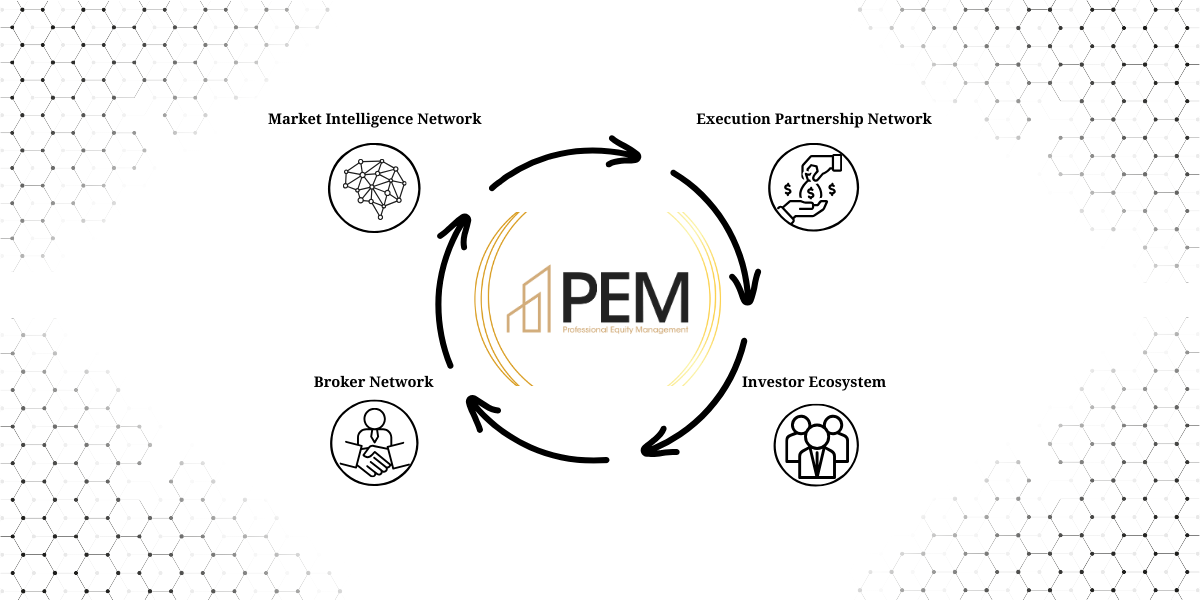
Real estate is ultimately a relationship business, but most approach it backwards—chasing deals first, building partnerships second. We’ve spent over three decades building what I call our network ecosystem: four interconnected relationship categories that create compound advantages impossible to replicate through capital or technology alone.
Our broker network spans every major Sun Belt market where we operate, built through decades of consistent execution—I personally maintain relationships with the primary contacts who have been in our markets since we began there. These same brokers handle both our acquisitions and exits; we always use the same broker to sell as we did to buy, creating long-term relationships where our reputation as a seller who structures win-win transactions generates competitive bidding and optimal timing. Our execution partners ensure reliable closings through established relationships with lenders, contractors, architects, legal teams, and consultants. Our market intelligence contacts provide early insights through industry connections and local operator networks. Our investor ecosystem provides patient capital and organic growth.
The strength of these connections has proven particularly valuable as we’ve expanded across markets. Many of our Detroit investors remain with us today, demonstrating enduring partnerships across decades and geographic markets. Our investors trust PEM’s thirty-one year track record and follow our recommendations when opportunities shift across markets—advantages built through proven performance rather than promises. We continually grow our investor ecosystem by encouraging existing investors to reach out to others, leading to high-quality referrals. This organic growth mechanism maintains the quality of our investor base while reducing the friction typically associated with capital raising, enabling us to focus on finding exceptional opportunities rather than constantly seeking new capital sources.
Each network reinforces the others systematically: our broker network generates opportunities and optimizes exits, execution partnerships close them reliably, intelligence networks time them strategically, and our investor ecosystem funds them with patient capital. This interconnection explains why authentic relationship capital cannot be quickly replicated—it requires time, consistency, and mutual value creation across all dimensions.
The compounding effect of these relationships becomes particularly evident during market stress. When financing markets tighten or transaction volumes decline, established relationships provide stability and continued access that purely transactional approaches cannot match. This durability across market cycles represents a fundamental competitive advantage in an industry where many participants struggle during downturns.
Relationship Advantages in Action
These networks aren’t theoretical—they create measurable competitive advantages across every deal we pursue. Three recent examples demonstrate how thirty-plus years of consistent partnership building translates into opportunities capital alone cannot access.
Off-Market Access: A Recent Acquisition
A recent acquisition represents everything that relationship-driven deal sourcing makes possible through our broker network. This syndication was off market, and the seller was looking for a buyer they knew would not waste time or risk a failed escrow. PEM knew the seller from a prior transaction and was closely tied to the broker involved.
This transaction started with a site visit, then negotiations with the Private Equity involved, then the seller, and finally after an Access Agreement and finalizing a PSA, the transaction was secured and on its way to closing. This asset was an institutional-quality project that could not be easily replaced. This asset at the price and terms negotiated was entirely a relationship-based acquisition.
The financial impact extends beyond the immediate transaction. Access to projects that never hit the market, awarded solely based on reputation and relationships, generates wealth that sophisticated investors cannot achieve through public market competition alone. Research on commercial real estate broadly shows that mass-marketed listings regularly command a 30% premium compared to off-market opportunities. While this data spans all commercial sectors, multifamily investors who access off-market deals through established relationships often capture similar pricing advantages—advantages that can equal the value of entire equity investments.
When you consider that a substantial majority of commercial real estate transactions now occur off-market, the ability to access this hidden inventory through partnerships rather than waiting for public listings creates systematic advantages that compound over time. But exclusive access means nothing without the execution capability to close deals reliably.
Execution Certainty: Twenty Years of Lending Partnership
While some focus on execution speed, our lender relationships deliver something more valuable: execution certainty. Twenty years of partnership with CBRE—who brokers for all agencies and life companies—means issues get resolved quickly and never impact a deal or closing. This isn’t just operational convenience—it’s competitive advantage during time-sensitive opportunities.
This execution certainty becomes particularly valuable in complex transactions or when market conditions create financing uncertainty. Recently, when a seller required an accelerated closing timeline due to their capital needs, our lender immediately assigned their senior team and prioritized the file. While competitors scrambled to secure financing commitments, we provided execution certainty that won the deal despite not being the highest offer. Our established relationships provide priority access, better terms, and the confidence needed to pursue aggressive opportunities others cannot execute.
This infrastructure extends to contractors, architects, legal teams, and consultants, providing confidence during time-sensitive opportunities beyond just operational efficiency. Our lender connections give us confidence to know a closing will happen, removing execution risk that derails competitors—from financing falling through at the last minute to extended approval processes that cause sellers to choose other buyers, or rate lock expirations during critical negotiations.
Beyond access and execution, our network delivers market intelligence that shapes strategy before competitors recognize emerging opportunities.
Market Intelligence: Strategic Expansion During Crisis
During the Global Financial Crisis, our financial relationships translated into us being one of the most active note buyers nationally, going from 5,000 units in Arizona to over 10,000 units across 14 states through acquisition of notes and distressed debt. This expansion wasn’t based on spreadsheets or market reports. It came from relationships within the financial community who understood our capabilities and provided access to opportunities that required immediate action and proven execution.
The intelligence advantage persists today across multiple dimensions. Knowing when assets become available before they reach the market represents the most valuable market intelligence we’ve found—having the ability to underwrite, bid on, and negotiate a purchase without any other competition generates material value. This early access often translates into acquisition opportunities at pricing that reflects true market value rather than competitive bidding premiums.
Through industry connections and local operator networks, we identify market inflection points and recognize regulatory changes that shape our entire investment approach. These relationships provide insights into everything from upcoming zoning changes to demographic shifts before they become widely recognized trends. While the commercial real estate industry now generates an estimated 1 trillion data points annually—up from 200 billion just five years ago—relationship-based intelligence offers distinct advantages that complement analytical capabilities. Beyond early market access, relationships provide context about seller motivations, quality filtering of opportunities, and insights into market dynamics that databases cannot capture. This combination of timing, context, and exclusive access translates directly into acquisition opportunities that others cannot access, regardless of their analytical sophistication.
After three decades, this network creates opportunities that would be impossible for newer market entrants to access. When combined with our market intelligence capabilities, consistent performance, operational excellence, and partnership integrity builds trust that accelerates every aspect of our business. We rarely discuss our network advantages with discerning investors. We find great deals and once we secure them, we tell our investors the story. We don’t market how we secure great deals; we simply explain how each deal was secured. Results speak louder than process explanations—this relationship-driven approach has generated significant wealth for PEM and our investors across multiple market cycles.
Partnership Built on Proven Infrastructure
Three decades of partnership building has taught us that the most valuable opportunities emerge through trust, consistency, and mutual value creation. While the industry increasingly emphasizes financial engineering and algorithmic approaches, the fundamental reality hasn’t changed: real estate is a relationship business where authentic connections create the greatest value.
The challenge for many investment groups is that building authentic relationship capital requires a fundamentally different approach than deploying capital quickly to meet fund timelines. Genuine partnerships develop through consistent behavior across multiple transactions and market cycles, not through promises or aggressive pursuit of individual deals. This patient approach to relationship building often conflicts with institutional pressures for rapid deployment and quick returns.
These relationship advantages enhance performance through better deal access, improved execution, and superior market timing. Rather than chasing maximum returns that require perfect execution, our approach focuses on superior risk-adjusted returns with margin for error. The real question isn’t whether partnerships matter—it’s having access to networks that take decades to build.
Our strategic focus on Sun Belt markets combined with our conservative investment philosophy creates the foundation where these advantages compound most effectively. In growing markets with strong fundamentals, established relationships deliver access to the best opportunities while reducing execution risk.
For family offices and sophisticated investors seeking risk-adjusted multifamily opportunities with direct access to leadership and decision-making, we’d welcome a conversation about how our proven relationship network might complement your investment objectives and provide access to the off-market opportunities that define our approach. In a world of institutional bureaucracy and committee-driven processes, we offer something increasingly rare: direct CEO access and the personal attention that only comes from authentic, long-term partnerships.
After all, in real estate, your network isn’t just your net worth—it’s your competitive moat.
About the Author
 Paul Mashni is the Founder and CEO of Professional Equity Management (PEM), a vertically integrated real estate investment firm specializing in multifamily properties. With over 30 years of experience and more than 25,000 apartment units acquired, Paul has successfully navigated five downturns while maintaining an average IRR of 20%+ since inception. His investment philosophy is guided by the principle that it’s “better to sell a year too early than a day too late.” His background in accounting and finance, along with his law degree from Wayne State University, informs PEM’s disciplined approach to investments. Paul holds a Bachelor of Science in Accounting and an MBA in Finance from Michigan State University.