
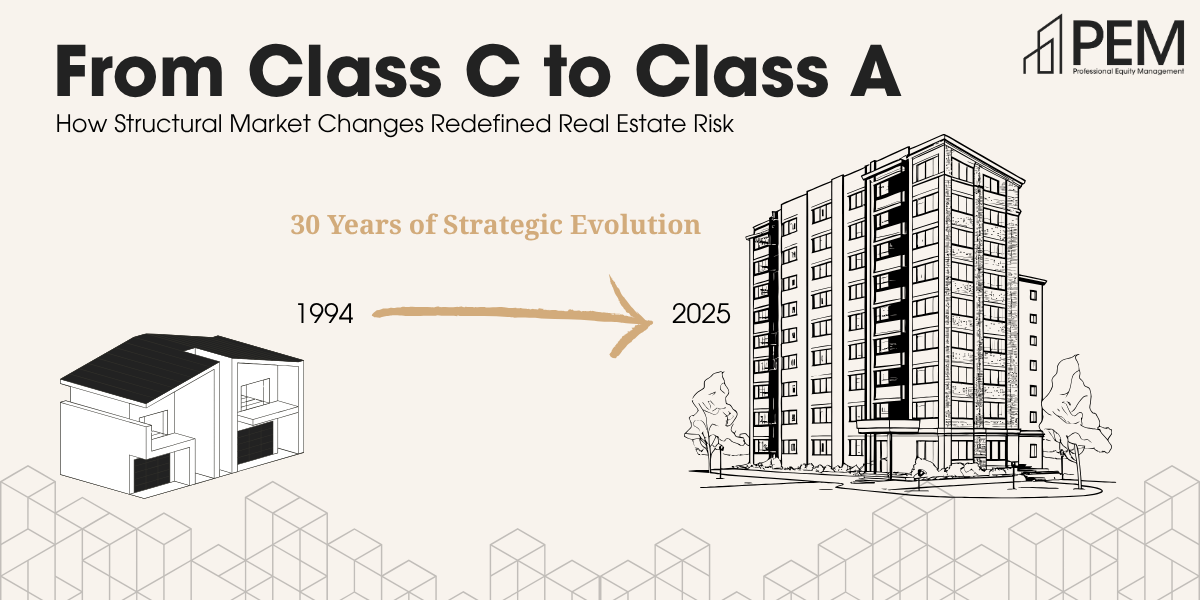
The conventional wisdom in multifamily real estate seems straightforward: higher quality assets deliver lower returns with less operational headache, while lower quality properties offer higher returns in exchange for more hands-on work. After thirty years moving between Class C, B, and A properties across market cycles, I can tell you the formula holds true.
But here’s what’s changed: the game itself.
This isn’t just another story about moving upmarket. It’s about how post-pandemic structural shifts—from eviction moratoriums to an unprecedented affordability crisis—have fundamentally altered what “risk” means in multifamily investing. The market cycles I navigated early in my career were primarily economic. Today’s cycles are increasingly regulatory and behavioral. And that distinction matters more than ever for investors trying to protect and grow wealth.
The Detroit Years: Learning in Class C
When I started buying rental properties in the early 1990s, I wanted to invest in Detroit’s suburbs. Better neighborhoods, better tenants, better sleep at night—or so I thought. Reality hit quickly: the equity requirements were substantial. At 20% down on higher-priced suburban units, my limited capital simply couldn’t stretch far enough to build a meaningful portfolio.
So, I pivoted down market to Detroit’s urban core, where lower-cost Class C units required correspondingly lower equity investments. The tradeoff was obvious: higher risk and more operational intensity, but dramatically faster portfolio growth for someone with more time than money. I became a hands-on operator out of necessity, yes—but also because I believed it was the only way to provide the level of care these residents and properties deserved. And it worked.
Success in Class C gave me confidence to test the suburban market again. I acquired a few higher-quality suburban units, expecting better risk-adjusted returns. Instead, I learned a foundational lesson: higher quality assets deliver lower returns precisely because they present lower risk. The math works differently when you’re not spending weekends dealing with maintenance emergencies.
I returned to Detroit’s urban market with clarity. Higher risk resulted in higher reward, but also significantly more work and tougher operating issues. For a young investor with limited capital and abundant energy, Class C made sense. But the experience planted awareness about how operational capability, risk tolerance, and capital availability need to align with asset class selection.
The GE Partnership: Class B and Crisis Validation
Moving to Arizona in the early 2000s created an opportunity to implement that awareness. Aligning with GE Capital as an investment partner fundamentally changed our capital position, enabling access to Class B properties—assets that were 10-20 years old, operationally stable, but still offering value-add potential.
This partnership proved fortuitous. When the Global Financial Crisis hit in 2008, the wisdom of holding higher-quality assets became undeniable. Our Class B portfolio weathered the storm with sufficient operational margin to absorb occupancy pressure. Meanwhile, Class C assets across the market struggled dramatically with delinquency, costly turnover, and extended vacancies. The GFC validated what I’d learned in Detroit: in downturns, quality matters exponentially more.
Post-GFC Through 2016: Strategic Opportunism
But market cycles create opportunities, not just risks. The aftermath of the GFC created an enormous distressed opportunity. From 2009 to 2016, we aggressively pursued Class C and distressed properties needing significant rehabilitation. The combination of discounted pricing, our operational expertise, and market recovery created exceptional returns. PEM grew from operating in one state to fourteen, proving our capability to execute complex rehabilitation projects at scale.
Yet discipline means knowing when a strategy has run its course. As our investment philosophy has always emphasized, by 2016, our success in rehabilitation prompted strategic reassessment. Real estate operates in cycles, and the run-up from 2009 to 2016 had been exceptional. Based on historical patterns, I expected a market correction by 2018 or 2019.
My philosophy: better to sell a year too early than a day too late. We began systematically upgrading our portfolio through 1031 exchanges, moving from extensive Class B and C holdings into newer Class A assets—completing the transition ahead of the anticipated downturn.
And for a while, it looked like we’d miscalculated. The pandemic hit, extending the cycle in ways nobody anticipated. Asset prices rose aggressively through 2020-2021 as low interest rates and aggressive rent growth created valuation expansion. Risk premiums compressed across all asset classes. When interest rates finally rose and cap rates expanded in 2022, the correction came—and our 2016 decision to pivot toward quality proved prescient. This kind of strategic positioning is only possible through vertical integration that gives real-time operational insight, combined with the discipline to act on that intelligence even when markets look favorable.
The Structural Shift: A Permanently Altered Landscape
The 2022 market correction brought predictable challenges: rising interest rates, expanding cap rates, declining values. But a more fundamental shift occurred during and after the pandemic that permanently altered multifamily investing in ways that transcend traditional market cycles.
Eviction moratoriums swept across major markets during 2020-2021, some lasting well over a year. The impact extended far beyond temporary relief. Tenant advocacy groups seized momentum to push rent control measures and expanded tenant rights protections. Courts and legal systems became decidedly more tenant-friendly, and those changes have proven durable.
New York enacted Good Cause Eviction protections effective April 2024, limiting rent increases to inflation plus 5%, capped at 10% total. California’s AB 1482 (Tenant Protection Act) caps increases similarly at 5% plus local inflation, maximum 10% annually. Colorado passed HB 24-1098 establishing for-cause eviction requirements. These aren’t temporary pandemic measures—they’re structural changes affecting real estate investing for decades. While PEM’s Sun Belt positioning has kept us in states that haven’t enacted the most aggressive protections, we still see downstream effects of the national shift in tenant expectations and behavior.
The regulatory changes occurred against an unprecedented affordability crisis. According to Harvard’s Joint Center for Housing Studies, 22.6 million renters are cost-burdened in 2023—spending over 30% of income on housing—representing 50% of all renter households. Those earning under $30,000 annually now dedicate 80% of their income to housing, up from 60% in 2001.
The consequences are stark: after paying rent, these households have a median of $250 per month remaining—a 55% decline since 2001. The Consumer Financial Protection Bureau reports that 14% of renters incurred late fees in the twelve months ending November 2024, with 60% experiencing multiple instances. This isn’t cyclical—it’s a structural crisis affecting tenant behavior in ways that directly impact operations. From our perspective, many tenants are prioritizing other lifestyle expenses above rent, and courts increasingly allow extended timelines before resolution. The burden to house the less fortunate is being shifted from government to landlords.
Operating expenses exploded simultaneously. Insurance premiums provide the starkest example: home insurance premiums jumped 57% from 2019 to 2024, with the sharpest increases in areas with greatest climate disaster risk. Multifamily property insurance premiums doubled on average from 2021 to 2024 in a Minneapolis Fed survey, with some operators reporting increases exceeding 45% year-over-year.
Beyond insurance, operating expenses rose $445 per unit between Q1 2021 and Q1 2024, remaining nearly 40% above pre-pandemic levels. Property taxes account for roughly 30% of total operating costs, continuing to climb after years of consecutive increases. This expense pressure hits all asset classes, but higher-quality properties typically have professional management infrastructure that can absorb cost pressures more efficiently.
Another subtle shift emerged: tenants are home significantly more than pre-pandemic as remote work became permanent for many households. This places substantially more wear on properties—HVAC systems run longer, appliances cycle more frequently, minor maintenance issues become urgent problems. All properties are experiencing operational impact from residents being present substantially more hours per week than historically normal.
Asset Quality in the New Reality
These structural changes converge to fundamentally alter risk profiles across asset classes in ways that transcend normal market cycles. During the 2020-2021 run-up, cap rates compressed dramatically and risk premiums essentially disappeared. Class C properties traded at cap rates barely differentiated from Class A. The market temporarily forgot that different asset classes carry meaningfully different risk profiles.
That’s changing. Cap rates are beginning to incorporate risk premiums based on asset class quality again, with spreads widening meaningfully between Class A and Class C properties. As collection challenges persist and operating costs remain elevated, NOI for lower-quality real estate faces increasing pressure relative to higher-quality properties.
The operational data supports this divergence. While occupancy stabilized across asset classes in 2024 following record supply, Class B properties led recovery with an 80 basis point gain to 95% occupancy, followed by Class C at 94.8% and Class A at 94.5%—a reversal from historical patterns. Renewal rates surged to 54% nationally as operators focused on retention, with Class A and B properties generally seeing stronger performance.
The past four years have been operationally difficult across all multifamily classes, but the critical difference: with Class A assets, operational issues are much more isolated and manageable than in Class C. Asset quality matters. Tenant quality matters. Today, both matter more than ever because the legal and economic environment has shifted fundamentally in ways that amplify the downside risk of lower-quality assets.
Investment Framework: Matching Strategy to Goals
This evolution leads to a straightforward framework for investors today:
If you’re protecting and growing long-term wealth: Class A and B+ properties (20 years or younger) deserve serious consideration. These assets attract tenants who care about their credit and won’t simply move after falling behind on rent. The regulatory environment may be challenging, but these properties have operational margin to navigate it.
If you’re starting out with little to lose: Class C can still offer opportunities, but requires hands-on operation and capital reserves for material risk and inconsistent returns. The potential rewards are real, but so are the challenges.
If you’re somewhere in between: Asset class selection isn’t about one approach being universally superior. It’s about alignment between your capital position, operational capability, risk tolerance, and investment timeframe. As our core values emphasize, integrity in investing means honest assessment of where you are and what you’re equipped to handle. Conservative leverage matters more in Class C precisely because operational and regulatory risks are higher. The relationships and market intelligence that create opportunity in any asset class become even more valuable when navigating structural headwinds facing lower-quality properties today.
When the Rules Change, Strategy Must Follow
Thirty years ago, market cycles were primarily economic phenomena. You watched interest rates, employment, housing starts, and rent trends. Those fundamentals still matter enormously. But today’s most significant variables increasingly involve regulatory environment, court behavior, and structural affordability trends that don’t follow traditional real estate cycles.
You can make more money with higher risk in lower-class assets—that part of the formula hasn’t changed. But it’s not consistent or stable. It’s high risk and high reward, heavily dependent on timing markets correctly. Class A assets are fundamentally long-term investment vehicles with much more stable performance and lower risk, particularly in an environment where tenant rights are expanding and affordability pressures show no signs of abating.
Our thirty-year track record wasn’t built by committing to a single asset class and riding it through all conditions. It was built by understanding when market conditions favor different strategies, having the operational capability to execute across asset classes, and maintaining the discipline to pivot when structural changes alter risk profiles.
The game has changed. For investors evaluating asset class selection, portfolio positioning, or investment timing in today’s complex environment, understanding how these structural shifts impact your specific situation isn’t optional—it’s essential. If you’re wrestling with these questions for your portfolio, I’d welcome the conversation. Three decades of navigating market cycles provides perspective on when flexibility matters and when conviction does.
The calculus for investors with wealth to protect has never been clearer: asset quality isn’t just about amenities—it’s about fundamental resilience in an environment where regulatory, economic, and behavioral factors increasingly favor assets that can command strong tenant quality and maintain operational margin under pressure.
Make sure your strategy reflects that reality.
 Paul Mashni is the Founder and CEO of Professional Equity Management (PEM), a vertically integrated real estate investment firm specializing in multifamily properties. With over 30 years of experience and more than 25,000 apartment units acquired, Paul has successfully navigated five downturns while maintaining an average IRR of 20%+ since inception. His investment philosophy is guided by the principle that it’s “better to sell a year too early than a day too late.” His background in accounting and finance, along with his law degree from Wayne State University, informs PEM’s disciplined approach to investments. Paul holds a Bachelor of Science in Accounting and an MBA in Finance from Michigan State University.